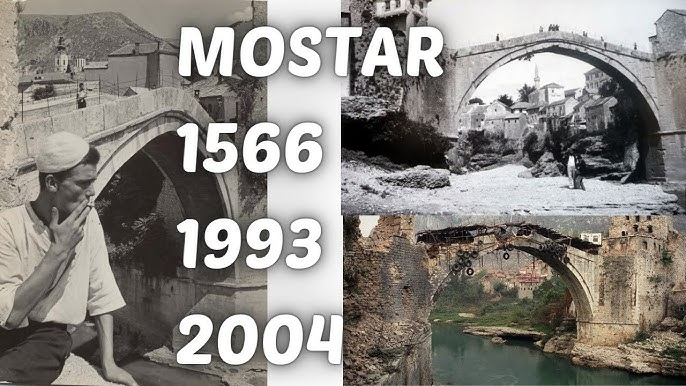
The Old Bridge in Mostar, known as Stari Most, stands as an iconic symbol of Ottoman architecture and multicultural harmony in Bosnia and Herzegovina. Spanning the Neretva River, this single-arch stone bridge has witnessed centuries of history, from its construction in the 16th century to its tragic destruction during the Bosnian War and triumphant reconstruction in the 21st century. Recognized as a UNESCO World Heritage Site, Stari Most embodies resilience, engineering prowess, and the enduring spirit of coexistence among diverse communities.
Construction in the Ottoman Era
Commissioned by Suleiman the Magnificent in 1557, the Old Bridge was designed by Mimar Hayruddin, a talented apprentice of the renowned architect Mimar Sinan. Construction began that year and lasted nine years, culminating in its completion in 1566. Built to replace a unstable wooden suspension bridge, Stari Most was engineered using local limestone, with a hump-backed single arch measuring approximately 29 meters in length, 4 meters in width, and soaring 24 meters above the river at its highest point. The bridge’s innovative design, anchored by stone abutments into the cliffs, made it the widest man-made arch in the world at the time. Legends surround its building, including tales of mortar strengthened with egg whites and Hayruddin’s fear of execution if the structure failed upon removal of the scaffolding.
The bridge connected the two sides of Mostar, an Ottoman frontier town that grew in economic and administrative importance. Flanked by fortified towers—Halebija on the northeast and Tara on the southwest—it served not only as a vital crossing but also as a testament to Balkan Islamic architecture. Ottoman explorer Evliya Çelebi described it as a “rainbow arch soaring to the skies,” highlighting its aesthetic and engineering marvel.
Historical Significance and Centuries of Use
For over 427 years, Stari Most symbolized tolerance and unity in a region where Muslims, Christians, and Jews coexisted. Mostar developed as a multicultural urban settlement blending pre-Ottoman, Eastern Ottoman, Mediterranean, and Western European influences. The bridge facilitated trade, social interactions, and cultural exchange, becoming integral to the city’s identity. Its name, derived from “mostari” (bridge keepers), underscores its central role in daily life.
The surrounding Old Bridge Area includes traditional Turkish houses, mosques, churches, synagogues, and a bazaar, reflecting a synthesis of natural beauty and human ingenuity. This historic urban site preserves archaeological layers from medieval times, emphasizing Mostar’s layered history.
Destruction During the Bosnian War
The bridge’s enduring legacy was shattered during the Croat-Bosniak War, part of the broader Bosnian War. On November 9, 1993, forces from the Croatian Defence Council (HVO) bombarded Stari Most with over 60 shells, causing it to collapse into the Neretva River. This act, ordered by commander Slobodan Praljak, was later deemed a war crime by the International Criminal Tribunal for the former Yugoslavia, viewed as deliberate cultural destruction or “memoricide” rather than a purely military necessity. The destruction symbolized the fracturing of communal bonds in Mostar.
In the aftermath, a temporary cable-stayed bridge was erected by Spanish engineers from the United Nations Protection Force, serving as a makeshift crossing until full reconstruction could begin.
Reconstruction and UNESCO Recognition
Post-war efforts to rebuild Stari Most began in earnest in 1998, led by an international coalition including the World Bank, UNESCO, the Aga Khan Trust for Culture, and contributions from countries like Italy, the Netherlands, Turkey, and Croatia. The project, costing around 15.5 million USD, aimed to replicate the original using authentic materials like tenelija limestone and Ottoman construction techniques. Reconstruction started on June 7, 2001, and the bridge reopened on July 23, 2004, as a beacon of reconciliation and international cooperation.
In 2005, the Old Bridge Area of the Old City of Mostar was inscribed as a UNESCO World Heritage Site under criterion (vi), recognizing its symbolic power as an emblem of coexistence among diverse ethnic and religious groups. The restoration preserved the site’s authenticity, integrating original elements and establishing management plans for ongoing protection.
Legacy and Current Status
Today, Stari Most is a pedestrian-only bridge and a major tourist attraction in Mostar. It hosts annual diving competitions, where brave individuals leap from its 24-meter height into the chilly Neretva—a tradition dating back centuries, formalized in 1968 and now part of events like the Red Bull Cliff Diving World Series. As a National Monument of Bosnia and Herzegovina, it continues to represent hope and unity, drawing visitors to experience its architectural beauty and historical depth.
The story of the Old Bridge in Mostar is one of creation, destruction, and rebirth, encapsulating the resilience of human heritage amid adversity.